 Contact
 Subscribe
 November 18, 2008

Concept cars have been around for a while. Every major motorshow, and vendors let their designers loose and parade around the results. Some of them are received so well they are actually made – I love the design that became the Lancia Stratos. Silicon Graphics seem to be going down this path with a fantastic piece of R&D madness at the Supercomputing 08 show.
Silicon Graphics have come up with the Molecule – 10,000 CPU cores in a single rack. Molecule uses the low power Intel Atom processor, which is more familiar from netbooks like the Asus EEE PC.
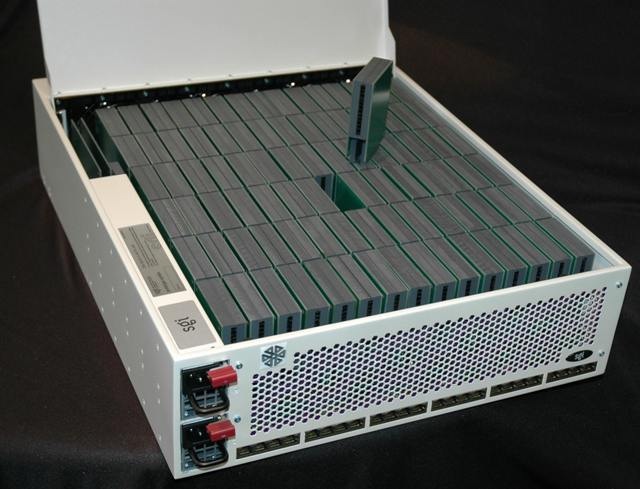
Much like Sun’s UltraSPARC T1 and T2 CPUs, such a high density of Atoms within a single system image would give massive horizontal scalability for multi-threaded applications – although Sun have yet to approach this sort of density.
SGI reckon Molecule has the following advantages:
- High concurrency with 20,000 threads of execution — 40 times more than a single rack x86 cluster system
- High throughput with 15TB/sec of memory bandwidth per rack — over 20 times faster than a single rack x86 cluster system
- Greater balance with up to three times the memory bandwidth/OPS compared to current x86 CPUs
- High performance with approximately 3.5 times the computational performance per rack
- Greener with low-watt consumer CPUs and low-power memory that deliver 7 times better memory bandwidth/watt
- Innovative Silicon Graphics Kelvin cooling technology, which enables denser packaging by stabilizing thermal operations in densely configured solutions
Molecule is still only a concept, but it’s cool for a number of reasons. First off it shows SGI are still capable of some pretty awesome R&D hackery. It could also point the way for the next generation of SGI’s single system image machines, like the Altix 4700s. You can check out the full press release at http://www.sgi.com/company_info/newsroom/press_releases/2008/november/project_kelvin.html
After the sad demise of Orion and their deskside super-cluster, maybe this will be the future of massively scalable computing? And with FPGAs becoming part of a large scale install, is this the fruit of Project Ultraviolet?
 molecule, project ultraviolet, R&D, silicon graphics